

The word ‘collaboration’ is today one of the most overused but least understood words in the lexicon of business.
Collaboration is assumed to be a natural human process being defined in most dictionaries as ‘the action of working with someone to produce something’.
This definition would best describe what most organisations today would refer to as ‘teamwork’; primarily internally focused.
When it comes to interactions with and between organisations the traditional relationship is around the ‘seller-buyer’ model primarily based in a legal contract.
Driven by the need to improve quality in production two major Japanese motor manufacturers, Honda and Toyota, in the late 1980s challenged the traditional ‘seller-buyer’ model by looking to ‘put aside the contract’ in favour of developing collaborative working relationships with their sup-ply chain where ‘businesses work together around a common purpose to achieve shared business benefit’.
‘A Leap of Faith’
Notwithstanding both organisations continual, and embedded, belief in ‘continual improvement’ through their ongoing commitment to the Quality Circle movement there would have been doubt and resistance, for they were now moving outside of their own organisation and cultures well aware that humans are ‘hard-wired’ to resist change.
However, with a strong clarity on the purpose (the benefit to be derived) – the improvement of quality – and strong internal forces pushing for this they took a ‘leap of faith’ where they believed the benefits to be gained would quickly far outweigh the costs.
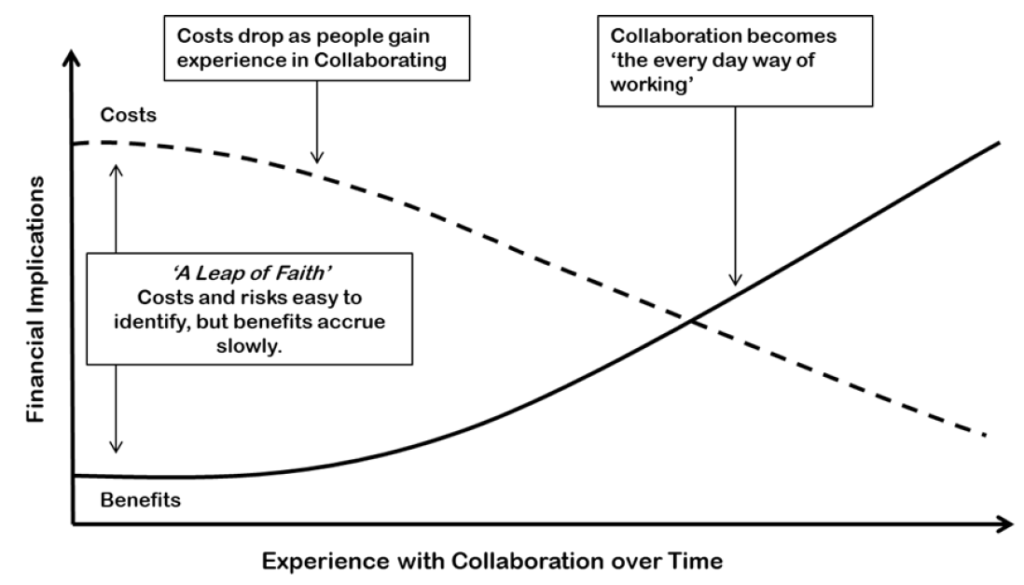
The approach taken both Japanese organisations has subsequently become known in the fields of business psychology and sociology as the ‘relational view’, with the potential outcome/s being su-pernormal and referred to as a ‘relational rent’: ‘A superior profit/performance/outcome generated in an exchange relationship that could not be generated by either party or parties in isolation and can only be created through joint idiosyncratic contributions of the alliance partners.’(1)
Despite the benefits obtained by the relational exemplars of Honda and Toyota, few organisations have successfully demonstrated a consistent ability to collaborate in a way that leads to distinctive competitive advantage. This is not surprising for collaboration as previously pointed out requires change, often behaviourally considerable, and humans are ‘hard-wired’ to resist change.
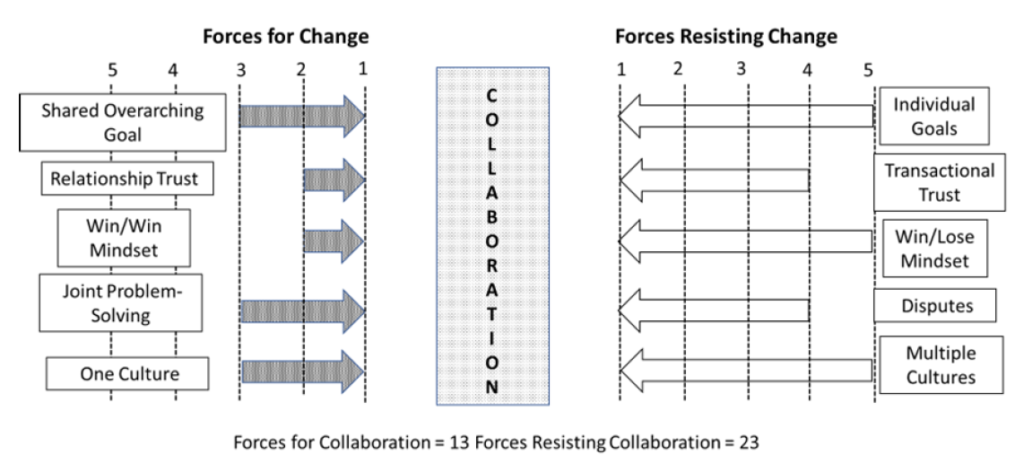
For change, and thus collaboration, to not just happen but to be effective the ‘driving forces’ for it have to be greater than the ‘resisting forces’ against it. Here lies the dilemma, for collaboration be-tween organisations requires humans to change many of their beliefs, attitudes, and behaviours – things that have worked so successfully for them as an organisation in the past.
Using the concept of ‘Force Field Analysis’(2) developed in the 1940s and widely used in business de-cision-making today we can apply a rating scale to assess the strength of the ‘forces’ in a potential Collaboration Initiative by collecting data from all of the parties.
As we can see in the diagram below that in this instance the ‘Forces for Change’ and this Collabora-tion (13) are totally outweighed by the ‘Forces Resisting Change’ and Collaboration (23).
(1) Dyer, J.H., Singh, H. (1998): The relational view: Cooperative strategy and sources of interorganizational competitive advantage. Academy of Management Review, Vol. 23, pp. 660–679.
(2) Lewin, Kurt (May 1943). “Defining the ‘Field at a Given Time'”. Psychological Review. 50(3): 292–310. Republished in Resolving Social Conflicts & Field Theory in Social Science. Washington, D.C.: American Psychological Association, 1997
© 2022 Executive Development 4
To embark on any collaborative endeavour in the above situation would rightly be seen not just ‘a leap of faith’ but also a foolish endeavour, for it carries high risks of failure.
Some business sectors have successfully taken ‘a leap of faith’ and used collaboration effectively, others have tried having learned lessons, whilst others have shown a considerable indifference to collaboration. The Construction Sector fits into the latter despite its merits having been promulgat-ed over the last 28 years in three key reports(3) .To support this view the data above in the ‘Force Field Analysis’ was collected from a Construction firm that lost out in a major international bid.
Why?
The Egan, Latham, and Wolstenholme reports all proposed threats to a belief system with which leaders in the Construction Sector were comfortable – a way of working that had served them well for 150 years. The propositions laid out to them posed ‘threats’ and whilst there were logical and rational reasons for change and collaboration they adopted the natural human ‘hard-wired’ reaction to change with resistance: the ‘drivers for change’ – the reports – were overshadowed by the ‘resistors of change’, the safety and comfort of what they knew.
A Highly Effective Way of Working?
Deciding to take the ‘relational view’ through collaboration, joint ventures, partnering initiatives, and projects is a means to an end and not an end in itself: It is about creating value for all of the par-ties involved.
This was certainly the view of Honda and Toyota who were working within a Japanese national cul-ture where the importance of relationships is highly valued and a far preferred way of working than the short-termism of a contract.
With this background the ‘forces for’ working collaboratively were potentially greater throughout their Supply Chain meaning that moving to collaboration and the co-creativity needed to ‘improve quality’ was a far less risky ‘leap of faith’. The starting point for the collaborative approach between the parties was most likely to co-operative with a fair level of trust.
Where collaborative initiatives start the journey is important. Too many potential collaborations start with a lack of purpose, ‘confrontational pasts’, or with those proposing the ‘collaboration’ ex-pecting compliance to ‘their way of doing things’. Overcoming these hurdles will take time for trust is vital and will take hard work with considerable patience by all of the parties that only a very few may hang-in for (see Diagram on next page).
(3)‘Constructing the Team’ (1994), The Latham Report; ‘Rethinking Construction’ (1998), The Egan Report; and ‘Never Waste a Good Crisis’ (2009), The Wolstenholme Report.
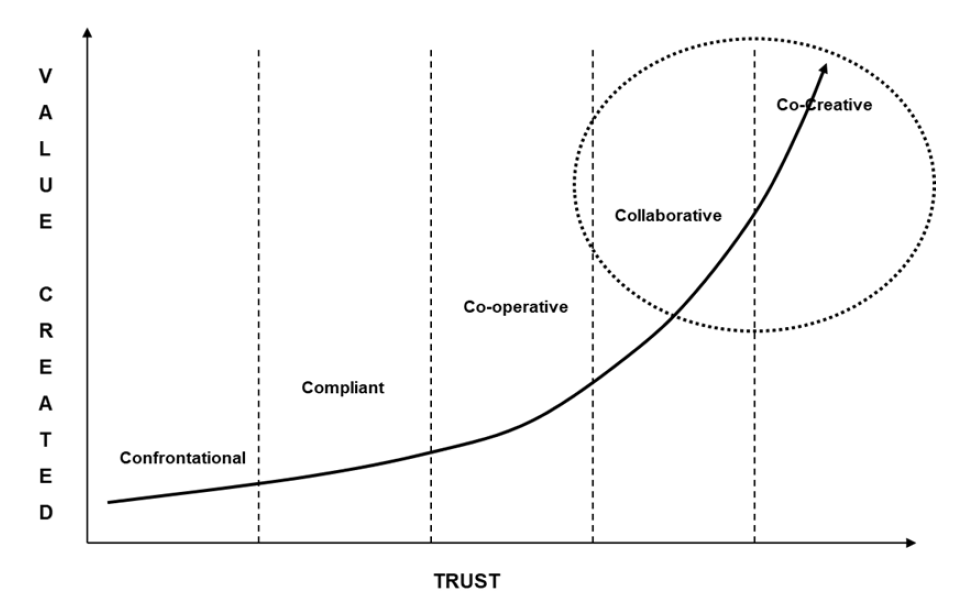
For those organisations that succeed collaboration is an highly effective way of working, for most, as did Honda and Toyota, discover that the initial benefit leads to many other benefits – the ‘relational rents’ are high.
Typically the benefits achieved are:
• Improved Quality
• Reduced project/contract delivery time
• Decreased costs
• Heightened productivity
• Joint problem-solving
• Reduced error
• Eradication of disputes
• Speedier decision-making
• Shared learning
• Elimination of error and other Non-Value Activities
• Mitigation of risk
• Relationship simplicity
• Co-creativity and Innovation
• Building of trust and long term relationships
• Heightened competitive edge
• Widened margin and potentially greater profitability
© 2022 Executive Development 6
It is has been estimated that businesses and organisations in the UK across all business sectors con-sume on average some 30% of their top line in Non Value Added activities e.g. meetings, disputes, error, etc. This sum is an average and likely to differ from business to business and sector to sector with many organisations exceeding this. The UK National Audit office, for instance, reckons through its work that the cost of NVA in the National Health Service has at times exceeded 60% or some 60p in every £1 of taxpayers’ monies.
NVA is pernicious and a feature most businesses and organisations do not understand and little to control. For instance, a contract won of some £20million may not actually be worth more than £14million – a stark erosion of potential gross income, margin, and profit totalling £6million.
Collaborative working between organisations can significantly reduce NVA, for much of the NVA generated by organisations is ‘soft’ skill and behavioural related. In our £20 million contract a reduc-tion of NVA by 5% would save £1million providing an attractive shared purpose for the parties to work upon. Of course, it is unlikely that this would be achieved without some investment in the be-havioural learning required to achieve it but this would certainly not exceed say £100,000, just 0.5% of the overall contract value or an ROI on the investment of 900%.
In slowing economic times where there are labour and skills shortages; high inflation; rising interest rates; supply chain challenges; flat or in ‘real terms’ declining productivity; and capital expenditure tightening the opportunities for collaboration have never been so plentiful.
As a business we have at Executive Development worked with many organisations over the last 35 years in advising, helping, and supporting them in all aspects of collaboration and collaborative working such as joint-ventures, partnering; collaborative initiatives, and projects. We would be very happy to discuss your needs and share our learning and experiences with you. Please contact: how-ardbetts@execdevelop.com